Author: Desiree Daniels

  • The Motivation Problem No One Talks About: Talent

    The Motivation Problem No One Talks About: Talent

    Parents often hear phrases like “She’s just not a math kid” or “He’s naturally gifted” as explanations for why one child excels, and another doesn’t. In fact, the way we talk about talent shapes how our kids see themselves, especially when things get hard.

    But what if we’re misunderstanding talent altogether?

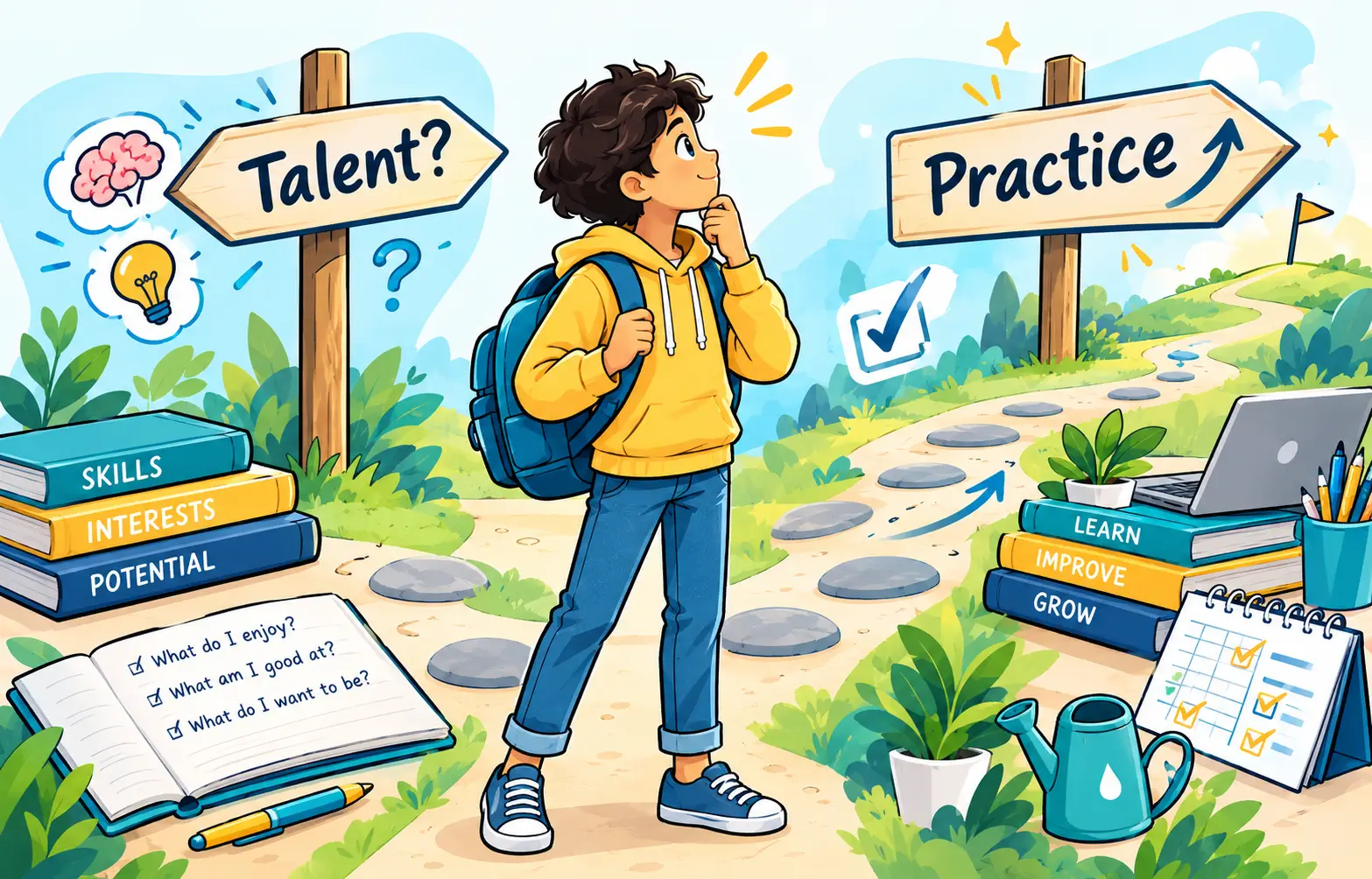
    There’s a big difference between talent as potential and skill as performance — and that difference matters for how children learn, grow, and build confidence.

    Talent Is Potential — Not a Finished Product

    When most people hear the word talent, they think of something innate — a gift that someone is “born with,” and others are not. But psychology and education research suggest that defining talent this way can be misleading and even harmful.

    Stanford psychologist Carol Dweck’s research on growth vs. fixed mindsets shows that when children believe their abilities are fixed traits — something you either have or don’t — they are more likely to avoid challenges and give up when things get tough. In contrast, those who view intelligence and ability as malleable — developed through effort, learning, and persistence — tend to be more resilient and motivated learners.

    In other words, talent is not the result — talent is the starting point.

    Another way to think about it is through a physics analogy: talent is potential energy — the stored capability. Practice and effort are kinetic energy — the force that turns potential into motion.

    Without that motion, potential just sits there. A child might have an intuitive inclination toward music or math, but unless that inclination is engaged through practice and effort, it never turns into an observable skill.

    Practice Matters — But It Isn’t the Whole Story

    Consistent practice indeed plays a critical role in the development of skills — from music to sports to academics. Research on deliberate practice, especially the work popularized by psychologist K. Anders Ericsson, has shown that long-term, focused practice helps people reach high levels of performance.

    At the same time, scientific reviews remind us that practice alone doesn’t entirely explain performance differences. A large meta-analysis looking at hundreds of studies found that deliberate practice accounted for substantial — but not total — differences in performance across domains, and in some areas (like education), the role of practice explained less than many people assume.

    What all of this suggests is that talent and practice are not mutually exclusive, nor is one universally more important. Rather, how we interpret and respond to talent matters most.

    Why Our Mindset About Talent Shapes Behavior

    Children don’t just observe their own abilities — they interpret them through the lens of what adults around them believe and model. If a child constantly hears that success comes from being “naturally gifted,” they may assume that skill is something you either have or you don’t. When faced with a struggle, failure becomes evidence of a lack of ability, not a normal part of the learning process.

    Conversely, children exposed to a growth-oriented message — that skills develop with effort, strategy, and time — are more likely to embrace challenges and persist through difficulty. This aligns with Dweck’s research showing that students with a growth mindset are more likely to persist, value effort, and achieve higher outcomes than peers with a fixed mindset.

    Changing the Way We Talk About Talent at Home

    So what does this look like in practice — at home and in everyday conversations with kids?

    Here are a few simple mindset shifts that make a big difference:

    1. Praise effort and strategy, not just performance.
      When you say things like “You worked really hard on that problem” instead of “You’re so smart,” you reinforce that progress comes from action and learning, not innate ability.
    2. Normalize struggle and setbacks.
      Challenges aren’t proof that a child lacks talent — they’re evidence that real learning is happening. They’re part of the motion that turns potential into performance.
    3. Help children set process-oriented goals.
      Skills develop most reliably when kids focus on what they can control — setting small practice goals, tracking progress, and building habits — not on proving how “good” they are.

    These shifts don’t mean ignoring a child’s natural inclinations. They mean reframing talent as the starting point, not the destination.

    What Experts Are Saying

    While the debate about the role of innate ability vs. practice continues in academic circles, there’s a growing consensus that ability is best understood as the product of interaction between predispositions and experience, not either/or.

    And even in studies that highlight limits to how much practice explains performance differences, one conclusion remains clear: practice matters significantly and isn’t something children should avoid simply because they feel they lack natural ability.

    Equally important, research shows that mindset — the belief that abilities can grow with effort — influences how children respond to challenges and setbacks.

    Final Thoughts

    Parents don’t need to reject the idea of talent — rather, they can redefine it in a way that empowers action instead of discouraging it. Because the truth is this: talent without practice stays silent. Practice without purpose goes nowhere. Only when potential meets sustained effort does learning and confidence take shape.

    That’s a message parents can use — and kids can carry with them long after the homework is done.

    If you are ready to take this redefining of talent a step further and see how Swoon Learning can help your child transform potential into resilient skill and lasting confidence, we invite you to book a free 30-minute discovery session with Ms. Carla today: https://www.swoonlearning.com/schedule-your-free-30-min-discovery-session

  • The Hype Around Growth Mindset

    The Hype Around Growth Mindset

    When Struggle Isn’t the End of the Story

    A middle school student sits at the kitchen table, shoulders slumped over unfinished homework. “I’m just bad at math,” they mutter, already defeated. Weeks later, after consistent feedback, strategy changes, and reassurance that mistakes are a part of learning, that same student begins tackling problems with curiosity instead of fear.

    The difference isn’t raw ability—it’s mindset.

    Psychologist Carol Dweck coined the terms fixed mindset and growth mindset to describe the beliefs people hold about intelligence and ability. In a fixed mindset, intelligence is seen as static: you either have it or you don’t. In a growth mindset, intelligence is viewed as something that can be developed through effort, strategies, and support. These beliefs fundamentally shape how students approach challenges, feedback, and setbacks—and they matter deeply for students, parents, and educators alike.

    Where Growth Mindset Began

    Carol Dweck’s research at Stanford University on what she calls “implicit theories of intelligence” laid the foundation for growth mindset theory. In her seminal book Mindset: The New Psychology of Success, Dweck explains that when students believe intelligence can grow, they are more motivated to learn, more resilient in the face of difficulty, and more likely to persist after failure.

    Decades of follow-up research support this framework. Studies summarized by the Association for Psychological Science show that mindset beliefs influence how learners interpret difficulty—either as a sign of incapacity or as a signal that learning is underway. This aligns with neuroscience research on neuroplasticity, which demonstrates that the brain physically changes in response to practice and learning, reinforcing the idea that effort and strategy matter.

    Key Characteristics of a Growth Mindset

    Educational psychology reviews describe several consistent behaviors associated with a growth mindset. According to Verywell Mind, these characteristics include:

    • Embracing challenges rather than avoiding difficult tasks
    • Persisting through setbacks instead of giving up after failure
    • Viewing effort as the pathway to mastery, not as a weakness
    • Learning from feedback rather than ignoring or resisting it
    • Finding inspiration in others’ success instead of feeling threatened by it

    These traits work together to support deeper engagement and long-term learning.

    Why Growth Mindset Matters

    A substantial body of research links growth mindset beliefs with positive academic outcomes. Reviews published by Teaching Commons and summarized by Verywell Mind indicate that students with stronger growth mindset beliefs are more likely to persist through academic challenges, seek help when needed, and recover from setbacks—behaviors associated with higher achievement over time.

    Growth mindset has also been associated with improved mental health and resilience. A 2020 study published in PLOS One found that individuals who endorsed growth-oriented beliefs about personal traits demonstrated lower levels of depression and greater resilience when facing stress.

    Beyond education, growth mindset principles appear in organizational and workplace research. Forbes reports that companies that emphasize learning, adaptability, and development over fixed notions of talent tend to see higher innovation, employee engagement, and long-term performance.

    Common Critiques and Pitfalls

    Despite its popularity, a growth mindset is not a cure-all. Meta-analyses discussed by Simply Put Psych highlight that many mindset interventions produce small to moderate effects—especially when mindset language is used without changing daily habits, feedback, or instructional practices.

    Another common pitfall is oversimplification. When a growth mindset is reduced to slogans or posters, it loses its power. Research consistently shows that mindset matters most when it is reinforced through repeated behaviors—how adults respond to mistakes, how feedback is given, and how effort is framed over time.

    Most importantly, a growth mindset is built through practice, not belief alone. Neuroscience research on neuroplasticity shows that the brain changes through repeated actions and habits, not one-time insights. Mindset sticks when it is embedded into everyday routines.

    Strategies to Cultivate a Growth Mindset

    To foster a growth mindset that lasts, students need repeated opportunities to practice growth-oriented behaviors. The following strategies translate research into tangible, actionable steps for homes and classrooms.

    • Shift praise to effort and strategy. Replace ability-based praise (“You’re so smart”) with process-focused feedback (“You tried different strategies” or “You stuck with that even when it was hard”). This reinforces the idea that learning is something students do, not something they either have or lack.
    • Normalize struggle early and often. Explicitly tell students that confusion and mistakes are part of learning. When adults respond calmly and constructively to errors, students learn that challenge is expected—not something to fear.
    • Teach how the brain grows. Research on neuroplasticity shows that the brain strengthens connections through repetition and effort. Explaining that practice literally builds new neural pathways helps students understand why effort matters.
    • Model growth mindset language. Adults set the tone. Saying things like “I haven’t figured this out yet” or “That didn’t work—let’s try another approach” demonstrates how to respond productively to difficulty.
    • Build reflection into routines. After assignments, tests, or projects, ask students: What was challenging? What strategy helped? What would you try differently next time? Reflection helps turn experience into learning.
    • Create habits, not slogans. Growth mindset strengthens through repeated behaviors—revising work after feedback, practicing difficult skills consistently, and setting small, achievable goals. Over time, these habits reinforce neural pathways associated with persistence and problem-solving.
    • Use feedback as a forward-looking tool. Feedback should guide next steps, not judge performance. When students see feedback as information for improvement, they are more likely to engage and apply it.

    These daily practices help translate a growth mindset from an abstract concept into a lived experience—one that reshapes how students approach learning over time.

    A Simple Metaphor

    Imagine a student building a spider web. The first attempt is fragile and uneven. With feedback—tighten this strand, reinforce that corner—the student rebuilds. Each iteration strengthens the structure. The growth mindset works the same way: listening, adjusting, and trying again. Progress emerges through reflection, not perfection.

    One Small Shift That Matters

    A growth mindset does not eliminate struggle—it reframes it. When students learn to see effort, feedback, and mistakes as part of the learning process, they become more resilient, motivated, and engaged.

    This week, try one small change: reframe praise, discuss how the brain learns, or reflect together on a mistake. Over time, these small shifts add up to something powerful—the belief that growth is always possible.

    Ready to turn mindset theory into student action? At Swoon Learning, we specialize in weaving the principles of a growth mindset directly into our academic sessions and executive function coaching, helping students build lasting resilience, motivation, and confidence. If you are ready to learn more about how we help your child unlock their full potential, sign up for a free 30-minute discovery call with Ms. Carla today.

  • Typing Feels Productive; Handwriting Actually Works

    Typing Feels Productive; Handwriting Actually Works

    Why Handwriting Still Matters: What Brain Science Says About Learning

    Keyboards have taken over in today’s fast-paced, digital world. Your teenager probably types most of their assignments and text messages to friends and even takes notes in an app instead of on paper. But what if the old-school handwriting skill does something powerful for the brain that typing simply can’t do?

    The latest findings in neuroscience and education point to just that: writing by hand engages the brain’s systems for learning and memory more than typing does.

    Handwriting Is a Brain-Based Learning Tool, Not Just an Old-School Skill

    Modern brain-wave studies (EEG) have shown that the brain exhibits more varied activity and connectivity across the brain when we simply write by hand compared to typing on a keyboard. One such high-density EEG study revealed that college-aged students writing words by hand showed a wide breadth of neural connectivity in the areas of the brain responsible for creating new memories and encoding information compared to those who typed, who showed almost no engagement.

    This finding demonstrates that handwriting is more than a motor task — it’s a multisensory experience that connects the motor act of writing with the visual, linguistic, and memory components simultaneously and helps facilitate learning outcomes.

    What Happens in the Brain When We Write?

    When kids write by hand, different brain regions engage:

    • Motor regions create the precise movements needed for writing.
    • Visual regions track the shapes on the page.
    • Memory and language processing regions build associations between what kids write and their meaning.

    The multisensory nature of handwriting creates stronger neural connections in the brain — something typing does not do. In contrast, repetitive typing tasks require less from the brain and body, making them less cognitively engaging.

    Handwriting as an Active Memory Tool

    Many parents hear, “But typing is faster!” — and they are correct. Typing can be a highly effective tool for students to quickly put their thoughts onto the “page.” Unfortunately, faster isn’t always better.

    Many research studies comparing handwritten and typed texts have shown that students who write by hand remember more of what they wrote later than if they typed. The slow process of handwriting gives the brain time to encode the material.

    Forgetting what we learn is a hallmark of cognitive learning processes. However, this isn’t an attempt to romanticize the practice of handwriting — it involves the way that the brain links physical activity to memory formation. This linking creates a neural “footprint” that helps students recall this information later on, something that typing does not.

    Handwriting Helps Students Build Essential Learning Skills

    Skills that your child will build by learning how to write by hand include:

    • Reading skills: Forming letters by hand helps kids learn letter shapes and sounds.
    • Spelling: Writing by hand makes spelling patterns stick more than typing.
    • Cognitive Control: The slower pace of handwriting builds attention spans, too.

    The research backs all of these foundations, showing how the brain integrates different sensory processes into a single motor action.

    How This Research Applies To Your Middle Schooler Or High Schooler

     to Your Middle Schooler or High Schooler

    For busy high schoolers and middle schoolers balancing reading comprehension, essay planning, note-taking, and studying, here’s how handwriting might improve their learning outcomes:

    1. Handwriting increases the quality of class notes. Typing encourages students to transcribe every word spoken during a lecture. Handwriting notes encourages students to summarize, paraphrase, and abstract the material, enhancing this processing phase for improved retention of key concepts compared to typing/lecture transcription.
    2. Summarizing concepts improves learning outcomes. When middle schoolers or high schoolers write essay summaries by hand, their higher order learning outcomes improve. Handwriting requires their brains to organize ideas before putting them on the page.
    3. Recalling concepts improves retention. Getting students to write by hand definitions/formulas as part of their studying will help them remember this information when it counts most — in their exams! Handwriting activates brain networks responsible for recalling information, something that typing does not do.
    4. Handwriting may support cognitive health. Some studies suggest that this kind of multisensory learning experience (handwriting) may help support cognitive health across the life span.

    Teach These Skills and Use Technology Responsibly

    This is not an either/or situation. Students need good typing skills to succeed in a school filled with technology (and if they want to succeed after school).

    Yet all the research suggests that technology should supplement, not replace, handwriting. Think of handwriting as a workout routine for your brain. 

    It should be included in your middle or high schooler’s homework, studying, and lessons, but not necessarily before every task.

    A combination of handwriting and technology can give students a full range of cognitive skills they will need later on and might even improve their enjoyment of tasks!

    Tips Parents Can Use To Encourage Handwriting Again

    No freak-outs! Handwriting does not need to play an outsized role in learning during this tech-driven period. However, it should still play an important role in students’ learning experiences. Here are some tips for parents:

    • Get middle schoolers/high schoolers to summarize material by hand after watching a lecture or reading material in a textbook or a work of fiction.
    • Use paper to recall information/formulae.
    • Use tablets with pen capabilities. These still engage the motor processes associated with handwriting.
    • Use paper for larger tasks! Writing essays can improve learning outcomes compared to typing.
    • Get middle schoolers/high schoolers to practice handwriting again! A few minutes of handwriting practice each day can help build fluency again.

    Handwriting Is More Than Tradition; It’s Brain Science

    Despite a shift in many classroom settings toward keyboards, handwriting has retained its role as an important learning tool in the classroom. Science backs up why an old-school skill still does something distinct for the brain compared to typing.

    Not only does handwriting engage the motor networks in the brain effectively, but it also engages the brain’s networks for memory formation and language processing, both of which help the learner retain information instead of just transcribing it.

    As your middle schooler or high schooler tackles increasingly complex academic work and battles self-doubt fueled by anxiety around tests, social pressures, and their own expectations, handwriting can offer them one pure learning-enhancing experience without any baggage attached!

    So, before your teen reaches for a laptop next time they need to tackle a homework assignment or task at school, hand them a pen, and their brain will thank you!

    Ready to put the science of handwriting into action for your student? Our method integrates these brain-based strategies to help your middle or high schooler achieve better learning outcomes. Book a free 30-minute discovery session today to learn more about how we blend the power of handwriting with modern study techniques to unlock your child’s full potential.

  • Your Child Is Smart, So Why Is School Suddenly So Hard?

    Your Child Is Smart, So Why Is School Suddenly So Hard?

    A lot of parents are shocked when their smart, capable child starts to have trouble in middle or high school. Their child’s grades drop, they lose assignments, and stress takes the place of the confidence they used to have. What makes this especially confusing is that nothing appears wrong with their ability. They know the material, participate in class, and can explain ideas clearly, but school suddenly feels like too much.

    In most cases, this fight has nothing to do with how smart they are. Instead, it shows how much school expectations change as kids get older and move into higher grades.

    The Change in What Is Expected During Middle and High School

    The truth is that schoolwork becomes a lot harder as students progress. Students have to juggle more classes, different teaching styles, long-term projects, and more work than they did before. Teachers offer fewer reminders, deadlines are less flexible, and students are expected to stay organized on their own.

    These changes happen quickly, and there isn’t always a lot of direct instruction on how to manage them. Even for highly intelligent students, the process of learning expectations through experimentation can be a stressful experience.

    Executive Function: The Skills That the School Thinks Students Have

    Executive function skills are what the brain uses to manage itself. Students use these skills to plan, organize, manage their time, initiate tasks, and adapt when they encounter obstacles. These skills commonly continue to improve as teens grow up, but being smart doesn’t necessarily mean that they will automatically develop strong executive function skills.

    In elementary school, students can rely on teachers and parents to manage them. As that structure diminishes in middle and high school, deficiencies in executive function become increasingly apparent. This phenomenon is why teachers say things like “capable but inconsistent” or “bright but disorganized” about their students.

    Parents and students can both become very upset when there is a big difference between ability and performance.

    Why Trying Harder Isn’t Enough

    A lot of smart students push themselves harder when they start to have trouble. They stay up late, rush through their work, or get more and more worried about school. Sadly, just trying hard isn’t enough to make planning or organizing systems. Students often feel overwhelmed, put off tasks, and burn out when they don’t have strategies.

    This can hurt their self-esteem over time. Smart students may think they’re failing, which can cause them to lose interest or feel stressed.

    How Executive Function Support Helps Kids Get Back to School

    When students are taught how to handle academic stress, everything changes. Students have a clear path to success when they learn how to break assignments down into steps, plan backwards from due dates, organize their materials, and set priorities for their tasks. School expectations become clearer and more achievable.

    As students develop better executive function skills, we see them become more confident. Parents often see that their kids have fewer emotional outbursts, are more consistent with their follow-through, and don’t panic at the last minute as much. The student’s effort finally matches their results, not because they got smarter, but because they learned how to handle their work better with executive function skills.

    What Parents Should Learn

    If your smart child is struggling in middle or high school, it doesn’t mean something is wrong—it means the academic environment changed, and they weren’t taught how to manage the new expectations. With explicit executive function support, students learn how to plan, organize, and take ownership of their responsibilities. As these skills strengthen, stress decreases, confidence grows, and school begins to feel manageable again.

    When students comprehend the expectations placed on them, they naturally progress.

    What Can Be Done?

    Is your bright, capable student suddenly struggling with organization, time management, or following through on tasks in middle or high school? It’s not a matter of intelligence, but a lack of explicit executive function strategies. Don’t let your child continue to feel overwhelmed or lose confidence. Take the first step toward reducing their stress and unlocking their full potential by booking a free 30-minute discovery session today.

    We’ll discuss your student’s unique challenges and how executive function support can make school manageable again.

  • Why Board Games Build Better Students

    Why Board Games Build Better Students

    Imagine a 7th grader leaning into his family’s living room table, playing Uno, and eyeing the last card in his hand while his friends wait for their turn.

    Is it just a 30-minute break from homework…or is it?

    As these students engage in strategy, memory, or planning-focused games, they’re actually exercising the same skills they’ll need to succeed in school: planning, working memory, organization, inhibition, and flexibility.

    Understanding Executive Functions for Parents & Teachers

    “Executive functions” are the mental “air-traffic control system” of the brain. They assist a student with starting a task, holding information in their mind, stopping themselves from acting immediately, shifting when necessary, and keeping themselves on track. Here’s what parents and teachers should know:

    • Working Memory: Keeping information in mind (steps for completion of a project/multifaceted instructions).
    • Inhibitory Control: Waiting one’s turn/impulsivity/focusing when distracting thoughts enter the room.
    • Cognitive Flexibility: Switching strategies when Plan A fails or adapting to new instructions/new rule applications.
    • Planning & Organization: Breaking large tasks into manageable pieces, keeping materials in order, and maintaining time management.

    These skills are most crucial for middle and high schoolers when expectations mount, projects grow longer and more intense, distractions run rampant, and the brain is still developing. Research notes that play-based and game-based development can meaningfully contribute to executive function development.

    How Board Games Naturally Exercise Executive Functions

    Let’s break down how gameplay complements the executive function skill set.

    1. Planning & Organization: Many games require players to think ahead of their moves: “If I take this route now, I can block their route later and earn points.” They must organize their pieces, manage resources, and keep track of available items. These games mirror homework projects or STEM assessments where students need to plan and allocate pieces/steps. Educational Resources notes that board games “simplify complex topics and skills into more manageable components” and are great for students who struggle in conventional lecture-style rooms.
    2. Working Memory & Attention: When you play a game with multiple parts, you’re remembering rules, keeping track of what’s already been played, watching what your opponent does, and anticipating their next turn. This involves working memory and sustained attention. One longitudinal study found that board game play in early childhood relates to better inhibition, switching, and updating.
    3. Cognitive Flexibility & Problem-Solving: In board games, things may not always go as planned. A player stands in your way, a card changes your course, a new rule emerges. You must then shift your strategy, be flexible, and adapt to spontaneous situations. This is the same muscle students exert when teachers change an assignment format or a lab experiment fails.
    4. Inhibitory Control & Emotional Regulation: Waiting turns, complying with rules (even if we want to cheat/get to the goal faster), handling frustration – all these promote self-regulation and emotional resilience. Cooperative games also build perspective-taking and regulation of excitement or annoyance. Therapy/OT-oriented materials suggest that games/toys are “an enjoyable and imaginative method for developing this skill” – especially regarding attention, organization, focus, and working memory.

    Thus, board games are not merely a “fun time,” they’re an exercise for executive functions in low-stakes, social contexts that provide motivation.

    Practical Skill Map: “This Game Builds That Skill”

    Here’s a quick cheat sheet for parents and educators, which you can share or cite at Swoon Learning:

    • Planning & Organization: Games focused on strategy/resource use (look for games you build with travels/routes, resources/cards in hand, etc.) or long-term goals.
    • Working Memory & Attention: Games where you need to remember what’s hidden from others or what’s been played before, as well as multi-step turns.
    • Flexibility & Problem-Solving: Games where rules change mid-play, spontaneous opportunities emerge, or you must switch gears.
    • Impulse Control/Self-Regulation: Games with turn-taking options, timed situations, or cooperative assessments where maintaining one’s emotional control is key.
    • Time Management/Multi-Stepped Execution: Games where each round has multiple steps within it, or rounds have time limits to help students practice starting, staying on task, and finishing within limits.

    Resources aimed at parents and educators stress that games can promote these skill areas.

    Making Game Time Intentional (Without Killing the Fun)

    During game time, to maximize the “executive function workout” and still keep it light/fun:

    • Name the Skill Out Loud: “Great job exercising your working memory by remembering which cards were left.”
    • Think Aloud/Model Planning: “I’m doing this now because I plan to block them from my route next time.”
    • Ask For Reflection Afterwards:
      • “What strategy did you implement this time?”
      • “If you played again, what would you do differently?”
      • “What happened when someone blocked your strategy? How did you accommodate?”
    • Make Slight Tweaks to Increase Challenge/Difficulty: For students who already play games, adjust timers, cards, or ask them to think ahead for two moves instead of one. For those who struggle, use easier game pieces with shorter expected play time or playing into teams/pairs so they don’t feel embarrassed.
    • Connect Game Strategies to School Strategies: “How you planned your move here is a lot like how you had to organize your science project – first deciding your goal, then what materials you’d need.”

    The ultimate goal is intentionality without feeling forced like another assignment.

    Board Games vs. Screens – Why the Table Matters

    It’s also important to note why analog board games often work better than screen-based play (when possible) relative to executive function training with younger players:

    • Face-to-Face Interaction: Major research (and reported outlets like The Washington Post) suggests that social play may provide additional brain benefits, not only for adults, but also for younger populations, for attention/self-regulation/sustained focus. For example, a new article from The Washington Post notes how board playing games link to lower dementia risk among older populations – and that “face-to-face play may have an additional benefit above playing them alone.”
    • Turn-Taking/Tangible Components/Slower Pace: Unlike many fast-paced digital games that reward rapid response, many sturdy board games reward planning, patience, observation, and strategy – all linked with executive function.
    • Less Screen Fatigue/More Verbalization: When students play at a table, there naturally emerges discussion/negotiation/reflection – all of which enhance cognitive/social pathways.
    • Low-Stakes Playing Opportunity to Fail and Recover: In a board game, you can mess up; you can retry next time. This enhances growth mindset/resilience, which comes part and parcel with self-regulatory EF.
    Conclusion

    At Swoon Learning, we see how students who develop their executive function muscles – planning ahead, staying organized, managing time used appropriately, and adapting plans – succeed in STEM independent studies and successful college applications. Board games are one of our favorite “secret weapons” because they allow students to practice those skills without even realizing it in a social context that’s fun! Next time you seek family fun or classroom involvement, think about dropping some games on the table! It’s more than entertainment – it’s brain training in disguise!

    Try this action step: Establish an Executive Function Game Night (15-30 min.) once per week for families/classrooms; have 1 reflection after each game: “What skill did I use during this game that will help me with my school assignments?”

    Over time, students will begin to make the connections on their own – and that’s a big step toward independence/growth mindset!

    Let the dice roll, let the cards shuffle – and the brains grow stronger!

    Ready to see how executive function coaching can transform your student’s success? Book a FREE 30-minute Discovery Session with Carla to discuss your child’s needs and how Swoon Learning can help.

    Schedule your session today.

  • 5 Signs Your Student Is On Track

    5 Signs Your Student Is On Track

    5 Signs Your Student Is On Track

    5 Signs Your Student Is On Track

    Families often feel both hopeful and unsure when a new term starts, especially after winter break. Routines change, schoolwork gets harder quickly, and students are suddenly expected to be more independent than they were before. This change can set the tone for the rest of the semester for students in middle and high school.

    A lot of parents ask the same thing at the start of the term: “How can I tell if my child is really doing okay?”

    Grades alone don’t always tell the whole story, especially at first. It’s more likely that habits, behaviors, and stress levels from day to day give the clearest picture. Here are five signs that your student might be starting the year off right, along with an explanation of why each one is important at this stage of development.

    1. Students are turning in their assignments on time. 

      Following through on assignments is one of the earliest indicators of how the school term will go. When students miss or don’t finish their work in middle and high school, it can add up quickly, making it harder for them to catch up later.

      A good start doesn’t mean being perfect; it means that most of the time, assignments are turned in on time, and if something is missed, your student will notice and fix it, ensuring there isn’t a growing pile of work that needs to be done.

      This is important because finishing assignments shows more than just how well you do in school. It shows that a student can handle deadlines, keep track of their tasks, and be able to neutrally respond to feedback. These are skills that become more important as students advance to higher grades.

      Students who stay on top of their work from the start of the term build confidence early on and avoid the stress of always trying to catch up.

    2. Your student understands what is expected of them in each class.

      Students in middle and high school must juggle multiple teachers, learning platforms, and classroom rules. It’s not a good sign at the beginning of the term if your child likes every class. It’s better if they know what they need to do.

    This could sound like a student saying, “I have a quiz on Friday and a project due next week,” or “My teacher puts homework in Google Classroom,” or “I know how this class grades participation.”Students don’t have to know everything, but they should understand the basic mechanics and expectations of each classroom. This understanding will help students plan instead of waiting until the last minute to react, which makes students less anxious.

    1. When students don’t know what is expected of them, they often avoid asking for help. Helping students understand what is expected of them early on can keep them from getting frustrated later.

    2. Students are tracking their work and assignment deadlines with a system.

      Every student has a different idea of what organization means. Some like to use paper planners, while others like to use digital tools, reminders, or class platforms. It’s not important which system they use as long as they are using one. Research on executive-function skills shows that students who consistently use an organizational system are significantly more likely to complete assignments on time and report lower academic stress (American Psychological Association).

      Some clear signs that a student’s system is working are that they know what needs to be done without being told all the time, they check their assignments on a regular basis, and they are able to confidently say, “What do you have planned for this week?”In middle and high school, the demands of executive function rise quickly. Students are expected to handle multiple deadlines on their own, even though they may not have fully developed those skills yet.

      A student who is trying out systems, even if they don’t work perfectly, is building an important base. These systems help people become less stressed and more independent over time, both in school and in life.

    3. They try hard work without giving up right away. 

      It’s normal to have trouble learning, especially when the work gets harder. A student who doesn’t have any problems is not necessarily a good sign; it’s how they deal with them.

      Students who start the year off well usually attempt their work even when it presents a challenge. They seek assistance or clarification when necessary and maintain engagement with tasks instead of procrastinating.

      This doesn’t mean that your student never gets angry. It means that being frustrated doesn’t always mean shutting down, saying no, or avoiding something.

      Middle and high school students need to learn how to deal with discomfort and keep going when things get tough. Students who do this early in the term are better able to handle more difficult schoolwork later on.

    4. Stress from school is there, but it’s not too much to handle.

      It’s normal to feel some stress, especially at the start of a new term. It can be hard to get used to new schedules, teachers, and expectations at first. It’s a good sign if stress is there, but doesn’t take over your life.

      Stress that you can handle might involve occasionally worrying before tests or due dates, sometimes needing comfort or help, and feeling like you are being pushed, but not always too much.

      Students can solve problems, stay interested, and bounce back from setbacks when their stress levels are low. When stress gets too much to handle, it can show up as avoiding things, having emotional outbursts, or not doing schoolwork.

      Without judging, ask your child how they feel about school. This can give you a good idea of whether their stress levels are healthy.

    Why are these signs more important than early grades?

    At the start of a term, grades are often limited or misleading. Patterns, habits, and emotional responses usually give a better idea of how things are going.

    These signs don’t mean that students are “doing well” or “doing poorly.” They are about spotting patterns early on, when small changes can have a big impact.

    These signs don’t mean that something is “wrong.” When a lot of them keep coming back, getting help early can stop small problems from getting bigger.

    Planning ahead and early on helps students build skills before the pressure rises, regain confidence before frustration sets in, and develop habits that support long-term success.

    For families, getting help early on often means less stress, fewer conflicts about schoolwork, and a better overall relationship with learning.

    One Last Thing

    Middle and high school are periods of rapid growth, academically and emotionally. No student does this perfectly, and needing help is not a sign of failure; it’s part of learning how to handle more responsibility.

    Families can make smart, proactive choices that help both their child’s academic success and their health by paying attention to these early signs.

    For families who recognize these patterns and want to make a proactive move, Swoon Learning offers personalized academic coaching that focuses on executive function and study skills. Our approach is designed to help students build the systems, mindset, and confidence needed for sustained academic success, turning early concerns into actionable growth strategies.

    Sign up today for a FREE 30-min discovery session with one of our academic coaches.

Get 30% off your first purchase

X